Top Fully Funded USA Scholarships for International Students in 2026 – The Fulbright Program Explained
Top Fully Funded USA Scholarships for International Students in 2026 – The Fulbright Program Explained
Studying in the United States remains the dream of millions of international students every year — and for good reason. American universities consistently rank among the best in the world, offering unmatched research opportunities, world-class faculty, and global career networks. But there is one major obstacle that stops most brilliant students from ever boarding that plane: the cost.
Tuition fees at top U.S. universities can range from $30,000 to over $80,000 per year, and that is before you add accommodation, health insurance, books, and living expenses. For a student from Nigeria, India, Pakistan, the Philippines, Brazil, or anywhere else in the developing world, those numbers can feel like a closed door.
The good news? That door is not closed. Every single year, the U.S. government, private foundations, and elite universities give away hundreds of millions of dollars in fully funded scholarships to international students. You do not need to be rich. You do not need a family connection. You need a strong academic record, a clear vision, and the willingness to apply.
In this guide, we break down the top fully funded USA scholarships for international students in 2026, with a deep, practical explanation of the most prestigious of them all — the Fulbright Foreign Student Program — and we’ll show you exactly where to apply.
🎯 Quick Apply Link: The official Fulbright Foreign Student Program portal is at foreign.fulbrightonline.org — select your country to find your local application page and current deadline. We explain the full step-by-step process further down this guide.
---Advertisement--- USA SCHOLARSHIPS:→
Stanford University Scholarships 2026 (Fully Funded)
 USA SCHOLARSHIPS:→
University of Minnesota Fellowship 2027 | Fully Funded
 UNITED-STATES:→
MIT Scholarships for International Students
 USA SCHOLARSHIPS:→
Marconi International University Scholarships 2026 | USA
 USA SCHOLARSHIPS:→
Illinois Wesleyan University Scholarships 2027
 USA SCHOLARSHIPS:→
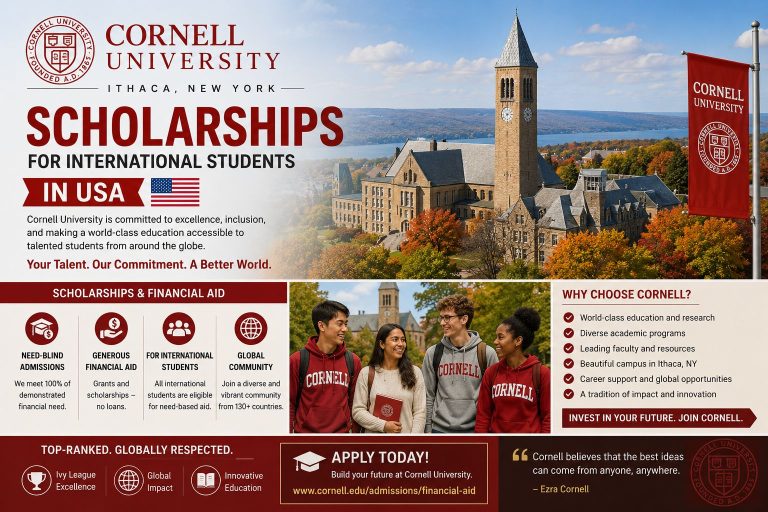
Cornell University Scholarships for International Students in USA
What Does “Fully Funded” Actually Mean?
Before we dive into specific programs, let’s clear up a term that gets thrown around loosely on the internet.
A fully funded scholarship is one that covers essentially all the costs of studying abroad, so you can focus on your studies without taking out student loans or worrying about how you’ll pay rent. A true fully funded award typically includes:
- Full tuition and mandatory university fees
- A monthly living stipend (rent, food, transport, personal expenses)
- Round-trip international airfare from your home country
- Health insurance for the duration of your program
- A book or settling-in allowance
- Visa and SEVIS fees in many cases
Anything less than this — for example, a “tuition waiver only” — is partial funding. You still need to find money for everything else, and in the United States, “everything else” can easily exceed $25,000 per year.
The scholarships covered below are the real deal: fully funded, prestigious, and open to international students for the 2026 academic cycle.
1. The Fulbright Foreign Student Program — The Gold Standard
If there is one international scholarship name everyone in academia recognizes, it is Fulbright.
The Fulbright Program was established in 1946 under legislation introduced by U.S. Senator J. William Fulbright. It is the flagship international educational exchange program of the U.S. government, sponsored by the U.S. Department of State’s Bureau of Educational and Cultural Affairs and administered by the Institute of International Education (IIE). The Foreign Student branch of the program enables graduate students, young professionals, and artists from abroad to study and conduct research at U.S. universities for one year or longer.
Approximately 4,000 foreign students receive Fulbright scholarships every year, drawn from more than 155 countries. That makes it not only one of the most prestigious — but also one of the largest — fully funded scholarship programs on Earth.
What the Fulbright Foreign Student Program Covers
The Fulbright grant is genuinely comprehensive. While the exact package varies by country, the standard benefits include:
- Full tuition and required university fees
- A monthly stipend for living costs
- Round-trip airfare from your home country to the United States
- A limited health benefits plan
- A book and equipment allowance
- Pre-academic training in some cases, including intensive English language preparation through the Long-Term English (LTE) program for candidates from selected countries
Crucially, Fulbright provides funding for the full duration of your study program — meaning that if you are accepted into a two-year master’s program, your funding is locked in for both years (subject to satisfactory academic progress and continued availability of funds).
Who Can Apply
The Fulbright Foreign Student Program is designed primarily for graduate-level study (master’s and PhD), as well as for non-degree research stays. Specific eligibility varies by country, but the baseline requirements are remarkably consistent:
- You must be a citizen or national of an eligible country (155+ countries participate)
- You must hold the equivalent of a U.S. bachelor’s degree (usually four years of university study)
- You must demonstrate strong academic performance and leadership potential
- You must have a clear research or study plan with measurable impact for your home country
- You must commit to returning to your home country after completing the program (Fulbright is an exchange program, not an immigration path)
- You must be proficient in English, or be willing to undergo intensive English training
- You generally cannot have previously studied for an extended period in the United States
Some country-specific programs have additional rules. For example, applicants from Uganda are encouraged to pursue master’s degrees in fields such as artificial intelligence, cybersecurity, health digitization, STEM, supply chain management, and trade. Applicants from many African countries are expected to be affiliated with academic or non-academic institutions and to return to those institutions after graduation.
Fields of Study
Fulbright is famously open. The program encourages applications across all academic fields, including the humanities, social sciences, STEM, business, the arts, public health, and interdisciplinary research. The one major restriction in most countries: medical degrees (MD) and clinical training programs in dentistry, medicine, pharmacy, and nursing are not eligible, although public health, biomedical research, and health policy degrees usually are.
The 2026 Application Timeline
Here is where it gets confusing for many applicants, so pay attention.
The Fulbright Program runs on a two-year application cycle. This means:
- The 2026–2027 cycle has closed in most countries (applications were submitted in 2024–2025; awardees started in fall 2026).
- The 2027–2028 cycle is the one you should be targeting if you are reading this in 2026. Applications opened in early 2026 in most countries, with deadlines falling between February and October 2026, depending on your nationality.
For example, Sierra Leonean applicants had to submit by April 5, 2026; Ugandan applicants by March 21, 2026; Rwandan applicants by June 30, 2026; and Bangladeshi applicants by July 11, 2026. Always check your local U.S. Embassy website for your country’s specific deadline — this is the single most common mistake applicants make.
👉 Where to Apply — Official Fulbright Links
Here are the official, verified application URLs. Bookmark this section.
| Resource | Official Link |
|---|---|
| 🌍 Find your country’s Fulbright office (start here) | foreign.fulbrightonline.org |
| 📝 Official Fulbright application portal (IIE) | apply.iie.org |
| 🏛️ IIE Fulbright program page | iie.org/programs/fulbright-program-for-non-us-students |
| 🇺🇸 Find your local U.S. Embassy | usembassy.gov |
⚠️ Important: Do not apply through third-party “scholarship agents” or sites asking for processing fees. The Fulbright application is 100% free. Any site charging you to apply is a scam. Use only the official links above.
How to Apply — Step by Step
- Visit your country’s U.S. Embassy or Fulbright Commission website. Start at foreign.fulbrightonline.org and select your country from the dropdown. This is your authoritative source.
- Confirm eligibility for your country, including age limits, degree requirements, and field restrictions.
- Take the required standardized tests. Most countries require TOEFL and the GRE. Some embassies provide free test vouchers to shortlisted candidates — ask.
- Prepare your documents. You will typically need:
- Academic transcripts (in English)
- A Statement of Purpose / Study Objective
- A Personal Statement
- A research proposal (for PhD or research-only applicants)
- Three letters of recommendation
- An updated CV
- Submit the online application at apply.iie.org under the country-specific portal.
- Pass the interview. Shortlisted candidates are interviewed at the local U.S. Embassy.
- Wait for placement. For many countries, once you are selected, the IIE places you at a suitable U.S. university on your behalf. For other countries, you must secure your own admission.
A critical warning: Fulbright operates a zero-tolerance plagiarism policy, which now explicitly includes content generated by AI tools like ChatGPT. Your essays must be 100% your own work. Applications are run through plagiarism-detection software, and any flagged submission risks disqualification.
2. The Hubert H. Humphrey Fellowship Program
If you are already a mid-career professional with at least five years of work experience, the Humphrey Fellowship may suit you better than Fulbright. Also sponsored by the U.S. Department of State, it is a 10-month non-degree program that combines graduate-level academic coursework with practical leadership development and professional placements at top U.S. institutions.
Humphrey Fellows are typically working in public service — government, NGOs, journalism, public health, education, or law — and the program is designed to sharpen their leadership and policy skills before returning home to drive change.
Coverage: full tuition, monthly stipend, accommodation allowance, textbooks, health insurance, a one-time computer allowance, and a professional development fund. Deadline: typically before October 1 annually (varies by country). 👉 Apply here: humphreyfellowship.org
3. The Knight-Hennessy Scholars Program at Stanford University
The Knight-Hennessy Scholars Program is one of the most generous — and most selective — graduate scholarships in the world. Launched in 2018, it funds up to 100 scholars per year across every graduate program at Stanford University, from MBA and JD to PhDs in engineering, medicine, and the humanities.
Coverage: full tuition for up to three years, a generous living and academic stipend, travel allowance, and access to the King Global Leadership Program (a separate leadership development experience that runs in parallel with your academic program).
Eligibility: You must apply to a Stanford graduate program separately and also submit the Knight-Hennessy application. Both must be successful. The program is open to citizens of any country, with no age or field restrictions.
Deadline: typically early October each year, for entry the following fall. 👉 Apply here: knight-hennessy.stanford.edu
4. The MIT Need-Blind Admissions Policy
The Massachusetts Institute of Technology is one of the very few U.S. universities that operates a need-blind admissions policy for international undergraduates. This means MIT does not consider your financial circumstances when deciding whether to admit you — and once admitted, MIT commits to meeting 100% of your demonstrated financial need through grants and scholarships, with no loans required.
For low-income international families, this is effectively a fully funded undergraduate degree at one of the best STEM universities on the planet. 👉 Apply here: mitadmissions.org
5. The AAUW International Fellowships
The American Association of University Women (AAUW) offers fully funded fellowships to international women pursuing full-time graduate or postdoctoral study in the United States. Awards range from $20,000 to $50,000 per year and are intended to support outstanding women who will return home to advance women’s education and rights in their countries. 👉 Apply here: aauw.org/resources/programs/fellowships-grants
6. The Mastercard Foundation Scholars Program
Specifically focused on talented young Africans and increasingly on Indigenous and refugee populations elsewhere, the Mastercard Foundation Scholars Program is a partnership with select U.S. universities (including Michigan State, UC Berkeley, and others) that provides fully funded undergraduate and graduate scholarships, plus mentorship, leadership training, and career support. 👉 Apply here: mastercardfdn.org/all/scholars
How to Maximize Your Chances of Winning a Fully Funded U.S. Scholarship
Across all these programs, the same patterns separate winners from rejected applicants. If you internalize these, your odds improve dramatically.
Start early. Strong scholarship applications are built over 12 to 18 months — not in two weekends. Begin standardized test prep (TOEFL or IELTS, plus GRE or GMAT where required) at least a year before your target deadline.
Tell a story, not a resume. Selection committees read thousands of applications listing impressive achievements. What sets winners apart is a clear, compelling narrative: who you are, what you want to do, why it matters, and why the United States is the right place to do it. Your Statement of Purpose should answer “why this program, why this country, why now, and what comes next?”
Quantify your impact. “Led a community project” is forgettable. “Designed and led a literacy program that taught 240 children to read across three villages over two years” is unforgettable. Numbers and outcomes prove leadership.
Choose recommenders who actually know you. A glowing letter from a junior lecturer who has supervised your research beats a generic letter from a famous professor who barely remembers your name.
Demonstrate a return-home plan. Fulbright and Humphrey both prioritize candidates who will return to contribute to their home countries. Be specific: name the institution, the role, the policy, the company, or the community you intend to serve.
Polish, then polish again. Have your essays reviewed by at least three people — ideally including a past scholarship winner or a writing tutor. Typos, vague claims, and grammatical errors signal carelessness to reviewers.
Frequently Asked Questions (FAQ)
Is the Fulbright application really free?
Yes. There is no application fee charged by the Fulbright Foreign Student Program. Your only out-of-pocket costs are standardized test fees (TOEFL, GRE) and document translations — and even those are sometimes reimbursed for shortlisted candidates.
Can I apply for Fulbright if I already have a master’s degree?
Yes. You can apply for a PhD or a second master’s degree as long as it is in a meaningfully different field or advances your career trajectory. What disqualifies you is having already studied long-term in the United States.
Do I need GRE or TOEFL before I apply?
In most countries, no — these are not required at the initial application stage. However, you will need them before final selection. Smart applicants take both tests in parallel with their application to save time.
What if I don’t get accepted the first time?
Many successful Fulbright scholars applied two or even three times before winning. Rejection is not the end. Request feedback if possible, strengthen your weakest area (often the Statement of Purpose or research proposal), and reapply the next cycle.
Are there age limits?
The Fulbright Foreign Student Program itself does not set a universal age limit, but individual countries may. Humphrey Fellows are typically between 30 and 50 with 5+ years of work experience. Knight-Hennessy and most university scholarships have no age cap.
Can I bring my family?
Fulbright grants do not cover dependents’ costs, but in most cases you may bring your spouse and children on J-2 visas at your own expense. The LTE preparatory year, however, does not allow dependents.
Which fields have the highest success rates?
STEM, public health, education, climate science, and public policy currently receive significant U.S. government priority. But Fulbright awards are made across all fields — a strong humanities application can absolutely win.
Your Next Steps — Start Today
A fully funded U.S. scholarship can transform your life, your family’s future, and the trajectory of your career. The Fulbright Program, in particular, has produced 60 Nobel Prize laureates, 89 Pulitzer Prize winners, and 41 heads of state or government since its founding — a legacy unmatched by any other educational exchange in modern history.
The competition is fierce. The rewards are extraordinary. And the most important thing to remember is this: the people who win these scholarships are not necessarily smarter than you. They simply applied — early, carefully, and well.
🚀 Take Action Right Now (5 Minutes)
Don’t close this tab and forget about it. Do these three things in the next five minutes — your future self will thank you.
- ✅ Visit the official Fulbright country page: Go to foreign.fulbrightonline.org and select your country from the dropdown menu. Read your country’s specific eligibility page right now.
- ✅ Find your local U.S. Embassy’s scholarship page: Visit usembassy.gov, click your country, and look for “Education” or “Exchange Programs.” This is where the exact deadline for your nationality is posted.
- ✅ Create your IIE applicant account: Go to apply.iie.org and register. Even if you’re not ready to submit yet, getting an account lets you save your progress and return any time. Most successful applicants start their account 6–9 months before the deadline.
📚 Keep Reading — Related Guides on This Blog
- How to Write a Winning Fulbright Statement of Purpose (with examples)
- TOEFL vs IELTS for U.S. Scholarships: Which Should You Take?
- The Complete Guide to U.S. Student Visa (F-1 and J-1) Interviews
- How to Get Strong Recommendation Letters for a Scholarship
- Top 20 Cheapest U.S. Universities for International Students
- Knight-Hennessy vs Rhodes vs Fulbright: Which Is Right for You?
Bookmark this guide, share it with one friend who deserves to study abroad, and start your application today. Your seat at a top American university could be 12 months away — but only if you apply.
Disclaimer: Scholarship eligibility, benefits, and deadlines change each year and vary by country. The information in this guide was accurate at the time of publication, but you must always verify current details on the official program website or with your local U.S. Embassy / Fulbright Commission before applying. This article is for informational purposes only and is not an official Fulbright, IIE, or U.S. Department of State communication.