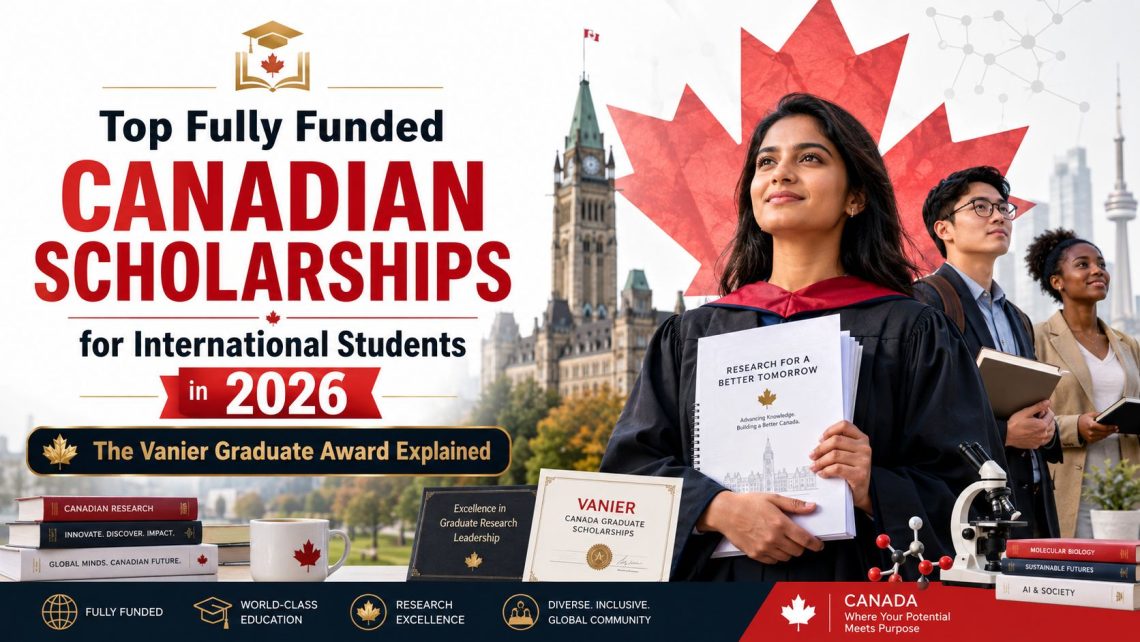
Top Fully Funded Canadian Scholarships for International Students in 2026 – The Vanier Graduate Award Explained
Canada has quietly become one of the most attractive study destinations on the planet. Affordable (relative to the U.S. or U.K.), safe, welcoming, and home to world-class universities like the University of Toronto, McGill, UBC, and McMaster — it is the country that ambitious international students are choosing in record numbers. The number of international students studying in Canada has roughly doubled in the past few years, and the trend shows no sign of slowing.
But there is a catch: international tuition in Canada is not cheap. A PhD program can cost anywhere from CAD $7,000 to over CAD $25,000 per year, and master’s programs at elite universities like McGill or U of T can run far higher. Add Vancouver or Toronto rent on top of that, and the bill becomes daunting.
The solution? Fully funded Canadian scholarships — programs that cover tuition, living costs, and sometimes even airfare. The Government of Canada, the country’s elite universities, and major private foundations award millions of dollars in funding every year, and a huge share of it is open to international students.
In this guide, we’ll walk through the top fully funded Canadian scholarships for international students in 2026, with a deep, practical breakdown of the most prestigious of them all — the Vanier Canada Graduate Scholarship — and we’ll show you exactly where to apply.
🎯 Quick Apply Link: The official Vanier Canada Graduate Scholarship portal is at vanier.gc.ca. Applications must be submitted through a Canadian university with a Vanier CGS quota — we explain the full nomination process further down this guide.
What Counts as a “Fully Funded” Canadian Scholarship?
Before we get into the specific programs, let’s define the term clearly — because many sites mislead applicants on this point.
A fully funded scholarship in Canada is one that covers essentially every major cost of studying abroad:
- Full tuition fees (or a substantial annual living and academic stipend that exceeds tuition)
- A monthly living stipend for rent, food, transport, and personal expenses
- Travel allowance or round-trip airfare in many cases
- Health insurance for the duration of your program
- Book, conference, and research allowances depending on the award
Anything less — for example, a “tuition reduction” or a partial entrance award — is not fully funded. You’ll still need to source the rest of your money, and in cities like Toronto and Vancouver, monthly living costs alone can reach CAD $1,800–$2,500 for a single student.
The scholarships below are the genuine, life-changing ones. They are also some of the most competitive awards in the world — but if you qualify, they are absolutely worth the effort.
1. The Vanier Canada Graduate Scholarship — The Gold Standard
If there is one Canadian scholarship name that opens doors globally, it is Vanier.
The Vanier Canada Graduate Scholarship (Vanier CGS) was launched in 2008 by the Government of Canada to attract and retain world-class doctoral students. It is named after Major-General Georges P. Vanier, the first French-Canadian Governor General of Canada, and its goal is straightforward: to establish Canada as a global center of excellence in research and higher learning.
Approximately 166 scholarships are awarded each year, and the program is open to Canadian citizens, permanent residents, and international students — which makes it one of the most coveted PhD funding opportunities in the world.
What the Vanier CGS Covers
The Vanier Canada Graduate Scholarship is worth CAD $50,000 per year for three years — a total package of CAD $150,000 over the duration of doctoral studies.
That single award amount is enough to cover tuition at virtually any Canadian university and provide a comfortable living stipend in major Canadian cities. Most Vanier scholars also stack this funding with university-level top-ups, research grants, and teaching assistantships — meaning total annual income can comfortably exceed CAD $60,000.
Who Can Apply
The Vanier CGS has strict eligibility requirements. To qualify, you must:
- Be pursuing your first doctoral degree — a PhD, or a joint program like MA/PhD, MSc/PhD, MD/PhD, DVM/PhD, or JD/PhD (only the PhD portion is funded)
- Not have completed more than 20 months of doctoral studies as of May 1 of the application year
- Be nominated by a Canadian university that has a Vanier CGS quota — you cannot apply directly to the Vanier program
- Have a first-class average (typically A- / 80%+) in the last two years of full-time study
- Be enrolled full-time at the nominating institution (part-time is allowed only for disability, parental, medical, or family reasons)
- Not hold — or have held — a doctoral-level scholarship from CIHR, NSERC, or SSHRC
- Demonstrate exceptional academic excellence, research potential, and leadership
The leadership criterion is critical. Vanier is not just looking for top grades — it is looking for future leaders. Selection committees weigh community engagement, professional contributions, mentorship, and a track record of taking initiative just as heavily as your academic record.
Eligible Fields of Study
The Vanier CGS funds doctoral research in three broad areas, each administered by a different federal agency:
- Health research (administered by CIHR — Canadian Institutes of Health Research)
- Natural sciences and engineering (administered by NSERC)
- Social sciences and humanities (administered by SSHRC)
This three-agency structure means almost every academic discipline you can imagine is covered, from quantum physics to indigenous studies to oncology to political theory.
The 2026 Application Timeline
The Vanier application cycle is annual, and the timeline is deceptively tight because of the two-step nature of the application:
- Step 1 (Spring/Summer): Identify the Canadian university you want to attend and contact the graduate program. Ask if they have a Vanier quota and whether they will nominate you.
- Step 2 (Summer): Universities set their internal deadlines, which are typically in August or early September, well before the national deadline.
- Step 3 (October–November): The national Vanier CGS application deadline is usually the first week of November each year. Your university submits nominated applications through the ResearchNet portal.
- Step 4 (April of the following year): Results are announced.
- Step 5 (September): Successful scholars begin their funded doctoral programs.
The big takeaway: if you want a Vanier scholarship starting in fall 2027, you should be reaching out to potential supervisors in early 2026 — at the absolute latest.
👉 Where to Apply — Official Vanier Links
Here are the official, verified application URLs. Bookmark this section.
| Resource | Official Link |
|---|---|
| 🌍 Official Vanier CGS website (start here) | vanier.gc.ca |
| 📋 Eligibility & nomination requirements | vanier.gc.ca/en/eligibility-admissibilite.html |
| 🖥️ ResearchNet application portal | researchnet-recherchenet.ca |
| 🏛️ Government of Canada scholarship hub | scholarships-bourses.gc.ca |
⚠️ Important: The Vanier application is 100% free. You apply through a Canadian university — never through a third-party “agent.” Any site charging you a “processing fee” for Vanier is a scam. Use only the official links above.
How to Apply — Step by Step
- Identify your research area and target universities. Vanier is a research scholarship. Before anything else, decide what you want to study and which Canadian universities have strong programs in that field.
- Contact potential supervisors directly. Email professors whose research aligns with yours. Introduce yourself, share a one-page CV, and explain your research interests. A strong supervisor relationship is the single biggest factor in winning.
- Confirm Vanier quota availability. Ask the graduate program coordinator whether the department has a Vanier nomination spot for the upcoming cycle.
- Apply for graduate admission to that university (this is a separate process from the Vanier application).
- Prepare your Vanier application documents. You will need:
- A two-page research proposal
- A leadership statement
- Academic transcripts (translated if not in English or French)
- Two leadership reference letters
- Two academic reference letters
- A common CV
- Submit through ResearchNet by your university’s internal deadline. The university then forwards nominated applications to the national competition.
- Wait for results in spring of the following year.
A critical warning: document formatting is strictly enforced. Files must be in PDF format, use standard fonts (Arial, Calibri, or Times New Roman, size 12), with proper margins and respect the page limits. Incorrect formatting can lead to disqualification — yes, really. Read the formatting guidelines twice.
2. The Lester B. Pearson International Scholarship (University of Toronto)
If you are an undergraduate applicant looking for a fully funded scholarship in Canada, the Lester B. Pearson International Scholarship at the University of Toronto is the crown jewel.
Named after the Nobel Peace Prize-winning former Canadian Prime Minister, the Pearson Scholarship is awarded to approximately 37 students worldwide each year, making it extraordinarily competitive.
Coverage: full tuition, books, incidental fees, and full residence support for four years. The total package is worth roughly CAD $180,000.
Eligibility: International students in their final year of high school, nominated by their high school (you cannot self-apply). Must demonstrate exceptional academic achievement, creativity, and leadership.
👉 Apply here: future.utoronto.ca/pearson
3. The McCall MacBain Scholarships at McGill University
Established in 2019 through a landmark CAD $200-million gift from John and Marcy McCall MacBain — the largest scholarship donation in Canadian history — the McCall MacBain Scholarships are Canada’s largest leadership-based scholarships for master’s and professional studies.
Each year, up to 30 scholars are selected (20 Canadians, 10 international), plus around 100 finalist and regional awards.
Coverage: full tuition for up to three years, a monthly living stipend of CAD $2,000–$2,300 during academic terms, relocation allowance, a summer activity grant, and access to academic enrichment funds for conferences and internships. Scholars also participate in an intensive interdisciplinary leadership program.
Eligibility: Open to international and Canadian citizens applying to a master’s or second-entry professional program at McGill (MBA, JD, DMD, MA, MSc, etc.). You must hold (or expect to hold) your first bachelor’s degree by August of the entry year. There is also a flexible “30 years old or younger” pathway for older graduates.
Application deadlines for the 2027 cohort: International applicants must apply by August 19, 2026; students and graduates of Canadian and U.S. universities, and Canadians abroad, by September 23, 2026. Applications open June 1, 2026.
👉 Apply here: mccallmacbainscholars.org
4. The Pierre Elliott Trudeau Foundation Doctoral Scholarship
For PhD students working at the intersection of academic research and public impact, the Pierre Elliott Trudeau Foundation Doctoral Scholarship is one of the most prestigious awards available in Canada.
Coverage: Up to CAD $60,000 per year for three years, plus an additional CAD $20,000 per year for travel and research expenses. Total value: up to CAD $240,000 over the scholarship period.
Eligibility: Doctoral students in the humanities and social sciences whose research addresses one of the Foundation’s four themes (Human Rights and Dignity; Responsible Citizenship; Canada and the World; People and Their Natural Environment). Open to both Canadian and international applicants.
👉 Apply here: trudeaufoundation.ca
5. The UBC International Scholars Program (University of British Columbia)
The University of British Columbia offers several major awards under its International Scholars Program, all aimed at exceptional international undergraduate students. The flagship is the Karen McKellin International Leader of Tomorrow Award, which provides funding to cover the full cost of attending UBC after considering your family’s financial contribution. Other awards in the program include the Donald A. Wehrung Award (for students from war-affected regions) and the International Impact Award.
Coverage: Need-based, but typically covers tuition, fees, and on-campus living costs for the duration of an undergraduate degree.
👉 Apply here: you.ubc.ca/financial-planning/scholarships-awards-international-students
6. The University of Alberta President’s International Distinction Scholarship
The University of Alberta — a top-tier research university in Edmonton — offers automatic merit-based scholarships to outstanding international undergraduates. The President’s International Distinction Scholarship is the most prestigious, valued at CAD $120,000 spread over four years of study.
No separate application is required — eligible candidates are automatically considered upon admission, provided they meet the academic threshold.
👉 Apply here: ualberta.ca/admissions/undergraduate
How to Maximize Your Chances of Winning a Fully Funded Canadian Scholarship
Across all six programs above, the same patterns separate successful applicants from rejected ones. Internalize these and your odds improve dramatically.
Start 12–18 months early. Strong applications take time — to identify supervisors, take English proficiency tests, draft research proposals, request letters of recommendation, and revise essays. Beginning your prep two months before a deadline almost always means a weak application.
The supervisor is everything (for research scholarships). For Vanier, Trudeau, and most PhD funding, a supportive faculty supervisor is the single most important factor. Email professors months in advance. Read their recent papers before reaching out, and reference specific work in your introduction.
Quantify your leadership. “Volunteered at a community center” is forgettable. “Founded and led a youth literacy initiative that taught 320 children to read across 8 schools over 18 months” is unforgettable. Numbers and specific outcomes prove impact.
Tailor every essay. A generic statement of purpose sent to multiple scholarships will lose to one custom-crafted essay every single time. Each program has different priorities — Vanier wants research excellence plus leadership, McCall MacBain wants character and community impact, Trudeau wants public-policy relevance.
Choose recommenders strategically. A passionate, detailed letter from a junior faculty member who has supervised your honors thesis beats a generic letter from a famous professor who barely remembers your name.
Polish ruthlessly. Have at least three people review your essays — ideally a writing tutor, a past scholarship winner, and a faculty mentor in your field. Typos and vague claims signal carelessness to reviewers.
Frequently Asked Questions (FAQ)
Is the Vanier scholarship really open to international students?
Yes. Unlike many country-specific awards, the Vanier CGS is explicitly open to Canadian citizens, permanent residents, and international students on equal terms. International applicants account for a meaningful share of every year’s cohort.
Do I apply directly to the Vanier CGS?
No. You must be nominated by a Canadian university that holds a Vanier CGS quota. The application is then submitted on your behalf through the ResearchNet portal.
Do I need IELTS or TOEFL for the Vanier CGS?
The Vanier program itself does not require a specific English test, but the nominating university almost certainly will for graduate admission. Most Canadian universities require an IELTS score of 6.5–7.0 or a TOEFL score of 90+.
Can I hold the Vanier alongside other funding?
You cannot hold the Vanier together with another doctoral-level award from CIHR, NSERC, or SSHRC. You can, however, stack it with university-level top-ups, teaching assistantships, and research grants — and most scholars do.
How competitive is the Vanier scholarship?
Extremely. Each university has a limited number of nomination slots (often only 2–10 per faculty area), and only the strongest candidates make it through the internal pre-selection — let alone the national competition. The acceptance rate at the national stage is roughly 20–25% of nominees, which sounds high until you realize nominees have already survived a brutal internal selection.
Are there master’s level fully funded scholarships in Canada?
Yes — the McCall MacBain at McGill is the most prominent. For master’s funding more broadly, most Canadian universities offer their own merit-based and need-based awards on top of program funding, especially in research-intensive master’s programs.
What if I don’t get the Vanier?
Many top doctoral candidates in Canada are funded through a combination of departmental funding packages (typically CAD $20,000–$35,000 per year), teaching assistantships, research assistantships, and smaller external scholarships. Don’t put all your eggs in the Vanier basket — negotiate funding directly with your prospective department even while applying for major external awards.
Your Next Steps — Start Today
A fully funded Canadian scholarship can pay your way through a degree at one of the world’s top universities, leave you debt-free, and open doors to a global career and even permanent residency in Canada through post-graduation work permits and the Express Entry system.
The competition is fierce. But here’s the truth: the people who win these scholarships are not necessarily smarter than you. They simply started earlier, prepared more carefully, and actually submitted.
🚀 Take Action Right Now (5 Minutes)
Don’t close this tab and forget about it. Do these three things in the next five minutes — your future self will thank you.
- ✅ Visit the official Vanier CGS website: Go to vanier.gc.ca and read the eligibility and nomination requirements carefully. Confirm you meet the 20-month doctoral study limit and academic average requirement.
- ✅ Identify your top 3 target universities: Search Canadian university graduate program pages for supervisors in your research area. Make a shortlist of three. Email one professor at each within 48 hours.
- ✅ Create your ResearchNet account: Go to researchnet-recherchenet.ca and register. Even if you’re not ready to submit, getting an account lets you save progress and revisit any time. Most successful applicants start their account 6+ months before submission.
📚 Keep Reading — Related Guides on This Blog
- How to Write a Winning Vanier Research Proposal (with examples)
- IELTS vs TOEFL for Canadian Universities: Which Test Should You Take?
- The Complete Guide to the Canadian Student Visa (Study Permit) Process
- How to Get Strong Recommendation Letters for a Canadian Scholarship
- Top 15 Cheapest Canadian Universities for International Students
- Vanier vs Rhodes vs Fulbright: Which Major Scholarship Is Right for You?
- How to Email a Potential PhD Supervisor in Canada (with a template)
- The Best Cities to Study in Canada for International Students 2026
Bookmark this guide, share it with a friend who deserves a shot at studying in Canada, and start your application today. Your seat at a top Canadian university could be 12 months away — but only if you apply.
Disclaimer: Scholarship eligibility, benefits, and deadlines change each year and vary by program. The information in this guide was accurate at the time of publication, but you must always verify current details on the official program website or with your prospective Canadian university before applying. This article is for informational purposes only and is not an official Vanier CGS, Government of Canada, or university communication.