Best UK Government Scholarships
For decades, the United Kingdom has been one of the top destinations for ambitious African students seeking world-class education, life-changing networks, and global career opportunities. From the historic halls of Oxford and Cambridge to the cutting-edge labs at Imperial College London and the AI hubs of Edinburgh, British universities have shaped generations of African leaders, scientists, doctors, journalists, entrepreneurs, and policymakers.
But the price tag of a UK education is a real obstacle. International tuition fees alone can run from £20,000 to £45,000 a year, and once you add living expenses in cities like London, Manchester, or Edinburgh, the total cost of a one-year master’s can easily exceed £55,000. For most African families, that’s simply impossible without serious external funding.

Denys Holland Scholarship 2027 | University College London

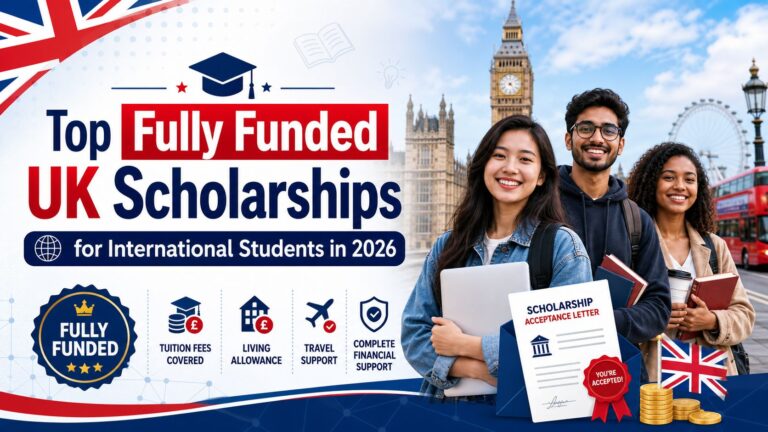
Top Fully Funded UK Scholarships for International Students in 2026 – The Chevening Opportunity…
University of East Anglia Scholarship 2026 (Application Process)
University of British Columbia Scholarship Opportunities for International Students

Kingston University Scholarships 2026 (Application Process)
The University of Dundee Scholarship 2026
Here’s the good news: the UK government runs two of the most generous, well-established, and genuinely accessible fully funded scholarship programmes in the world — and both are explicitly designed with African students in mind. Together, they fund hundreds of African scholars every year across virtually every field of study.
If you’re an ambitious student from Nigeria, Kenya, Ghana, Uganda, Tanzania, Rwanda, South Africa, Zambia, Zimbabwe, Cameroon, Sierra Leone, Malawi, Botswana, Egypt, Ethiopia, Senegal, Mozambique, or any other African country, this guide is for you. We’ll walk through the two flagship UK government scholarships available to African students in 2026 — the Chevening Scholarship and the Commonwealth Scholarship — and explain exactly how to position yourself to win.
Why UK Government Scholarships Matter for African Students
Before diving into specific programmes, let’s address the bigger question: why are UK government scholarships such a powerful opportunity for African students specifically?
They’re truly fully funded. Unlike many partial scholarships that cover only tuition or only living costs, the two flagship UK government scholarships cover virtually everything — tuition, monthly stipend, return flights, visa fees, health surcharge, and arrival allowances. You can attend with zero out-of-pocket cost.
They’re designed to benefit Africa. The UK government has long-standing diplomatic, educational, and development partnerships with African nations. African students are not afterthoughts in these programmes — they are central to the mission. Year after year, African scholars make up a substantial percentage of total awardees.
They open doors that stay open. A degree from a top UK university combined with the prestige of a Chevening or Commonwealth Scholarship signals to employers, governments, and international organisations that you are part of a globally recognised cohort of emerging leaders. The doors this opens — at the World Bank, UN, AU, multinational corporations, top universities — are extraordinary.
They build lifelong networks. Both programmes have alumni networks spanning Africa and the rest of the world. Many African heads of state, vice-chancellors, ministers, CEOs, and judges are former UK scholarship recipients. Once you’re in, you’re in for life.
They directly counter the financial barrier. Without these scholarships, the vast majority of talented African graduates would never set foot in a UK lecture hall. With them, your financial background becomes irrelevant.
Now let’s break down the two flagship UK government scholarships open to African students in 2026.
1. The Chevening Scholarship – The UK Government’s Flagship Award
The Chevening Scholarship is the UK government’s flagship international scholarship programme, funded by the Foreign, Commonwealth and Development Office (FCDO). It has been running since 1983 and has supported more than 60,000 scholars from over 160 countries. Africa has consistently been one of the largest recipient regions.
What Chevening Covers
Chevening is fully funded and covers full tuition fees at any eligible UK university, a generous monthly living stipend (with London-based scholars receiving more), return economy airfare from your home country to the UK, an arrival allowance to help you settle in, a homeward departure allowance, visa application fees, the Immigration Health Surcharge granting full NHS access, and a travel grant for Chevening-organised events.
In total, a Chevening Scholarship is typically worth £40,000 to £55,000+ — a complete, no-strings-attached funding package for one academic year.
Who It’s For
Chevening targets emerging leaders. The selection committee is fundamentally asking: “Will this person return home and shape the future of their country?”
To qualify, you must be a citizen of an eligible country (every African country except a small number of exceptions is included), have completed an undergraduate degree equivalent to a UK 2:1 (upper second-class), have at least two years (2,800 hours) of work experience including volunteer and internship work, apply to three different one-year master’s programmes at UK universities, and commit to returning home for at least two years after your studies end.
What Chevening Looks for in African Applicants
Chevening evaluates four core competencies: leadership and influence, networking, a clear study plan, and a clear career plan.
For African applicants specifically, the strongest applications tell a vivid story of impact-in-progress. The committee wants to see that you’ve already started shaping your community, your sector, or your country — and that the master’s degree is the missing ingredient that will help you scale that impact dramatically.
Don’t undersell yourself. African applicants often write modestly about their achievements when, by global standards, they’ve done extraordinary things — building schools, launching tech startups, leading youth movements, transforming local NGOs. Tell those stories with specificity, numbers, and confidence.
How to Apply for Chevening 2026
The application cycle typically opens in early August and closes in early November of the year before your studies begin. So for September 2026 entry, applications open around August 2025 and close in early November 2025.
The application requires four written essays (typically 500 words each) on leadership and influence, networking, your study plan, and your career plan. You also need to apply to three eligible master’s programmes at UK universities and secure at least one unconditional offer by mid-July.
The selection process moves through application submission, shortlisting (around February-March), reference letter and document submission, interviews at the British High Commission in your home country (around March-May), conditional award, university offer confirmation, and final award by July.
👉 Apply for the Chevening Scholarship here: https://www.chevening.org/apply/
2. The Commonwealth Scholarship – Designed for Development Impact
The Commonwealth Scholarship is the UK government’s other major scholarship programme, administered by the Commonwealth Scholarship Commission (CSC) and funded by the Foreign, Commonwealth and Development Office. Established in 1959, it has supported more than 30,000 scholars from across the Commonwealth — and Africa has always been a major beneficiary region.
While Chevening focuses on emerging leaders, the Commonwealth Scholarship has a sharper development focus. It explicitly targets candidates whose studies will contribute to sustainable development in their home countries.
What the Commonwealth Scholarship Covers
The Commonwealth Scholarship is genuinely comprehensive and includes full tuition fees, a monthly maintenance stipend, return economy airfare, an arrival allowance, a thesis grant for PhD scholars, study travel grants for fieldwork and conferences, family allowances in some cases for scholars with spouses and children, visa fees, and Immigration Health Surcharge reimbursement.
For master’s scholars, the package is typically worth £40,000 to £55,000+. For PhD scholars, the total value over three years can exceed £100,000.
Who It’s For
The Commonwealth Scholarship is open to citizens of low- and middle-income Commonwealth countries — which covers the vast majority of African nations including Nigeria, Kenya, Ghana, Uganda, Tanzania, Rwanda, South Africa, Zambia, Zimbabwe, Sierra Leone, Cameroon, Malawi, Botswana, Lesotho, Mozambique, Mauritius, and many others.
Eligibility requires citizenship and permanent residence in an eligible Commonwealth country, a strong undergraduate degree (typically a 2:1 or equivalent), demonstrated financial need, and a clear plan to return home and contribute to your country’s development.
Crucially, your proposed study must align with one of the CSC’s six development themes: science and technology for development, strengthening health systems and capacity, promoting global prosperity, strengthening global peace and governance, strengthening resilience and response to crises, and access, inclusion and opportunity.
Different Tracks Within the Commonwealth Scholarship
One of the great advantages of the Commonwealth Scholarship is its flexibility. Multiple tracks exist, including Master’s Scholarships (one-year taught programmes), PhD Scholarships (three years of doctoral research), Split-Site PhD Scholarships (12 months in the UK as part of a home-country PhD), Distance Learning Scholarships (online UK master’s while staying in Africa), Shared Scholarships (jointly funded with UK universities), Professional Fellowships (5-10 weeks of professional collaboration), and Medical Fellowships (clinical training for medical professionals).
For most African applicants, the Master’s or PhD tracks are the most common entry points. But the Distance Learning option deserves special attention — it allows you to earn a UK master’s while continuing to live and work in your home country.
What the Commonwealth Selection Committee Looks For
The committee evaluates academic merit, proposed development impact, quality of the study or research plan, commitment to your home country, financial need, and leadership potential.
The unique feature of the Commonwealth Scholarship is its emphasis on financial need. If you’re from a less-privileged background — rural area, low-income family, underrepresented community — that’s actually an advantage in this programme. The CSC explicitly funds candidates who couldn’t otherwise afford UK study.
How to Apply for the Commonwealth Scholarship 2026
The application cycle typically opens in August or September and closes in mid-to-late October of the year before studies begin. So for September 2026 entry, expect to apply between August and October 2025.
Most African applicants apply through a national nominating body in their home country — usually a government ministry, scholarship commission, or designated NGO. Each country has its own designated nominating body, listed on the CSC website.
The application requires you to identify a UK university and course, write a strong development impact statement, secure professional and academic references, and submit to both your nominating body and the CSC online portal.
The selection process involves country-level nomination, CSC expert panel review, and final award notification typically between March and June.
👉 Apply for the Commonwealth Scholarship here: https://cscuk.fcdo.gov.uk/apply/
Chevening vs. Commonwealth – Which Should African Students Apply For?
This is the most common question African applicants ask, and the simple answer is: apply for both if you’re eligible.
There’s no rule against applying to multiple UK government scholarships in the same cycle. The application periods overlap, the documents required are similar, and the marginal effort to apply to a second programme is small compared to the upside of doubling your chances.
That said, here’s how to think about which programme fits you best:
Chevening fits you better if you have strong leadership and networking experience, want to study a one-year taught master’s, can frame your goals around becoming a future leader, and have at least two years of work experience.
Commonwealth fits you better if you’re focused on a specific development challenge in your country, want to pursue a PhD or research-heavy master’s, come from a less-privileged background where financial need is genuine, or want flexible options like distance learning or split-site PhD.
Apply for both if you tick the boxes for both. Many African scholars have submitted applications to both programmes simultaneously and won one — and occasionally, both.
How to Position Yourself as an African Applicant
Whichever programme(s) you target, certain principles will dramatically improve your chances:
Start your preparation 6-12 months before the deadline. The strongest applications take months to refine. Begin essay drafts, research universities, and identify referees long before the cycle opens.
Choose your UK universities and courses strategically. Don’t just chase Oxford and Cambridge. The committees value fit over prestige. A specialised programme at the University of Sussex (development), the London School of Hygiene and Tropical Medicine (public health), the SOAS University of London (Africa studies), or the University of Edinburgh (data science) may be a far stronger match than a generic Oxford course.
Tell specific, measurable stories. Generic claims like “I am a strong leader” are forgettable. Concrete stories — “I co-founded a coding bootcamp that has trained 240 women across three Nigerian states” — are unforgettable.
Tie everything to impact in your home country. Both programmes exist to build leaders who will return and transform their nations. Every paragraph of your application should ultimately answer the question: what will I do back home, and why does this scholarship make that possible?
Get external feedback. If you can find a Chevening or Commonwealth alumnus in your country (LinkedIn is your friend here), reach out for application reviews. Their insights are invaluable.
Apply early in the cycle. The systems get congested in the final 48 hours before deadlines. Aim to submit at least a week before close.
Don’t self-eliminate. Many African applicants assume they’re not “good enough” and never apply. Both programmes actively want to fund African scholars. If you’re eligible, apply. The worst outcome is being told no — and even rejected applicants often win in subsequent cycles.
Other UK Scholarships Worth Considering
While Chevening and Commonwealth are the two flagship UK government scholarships, savvy African applicants apply broadly. Other well-known UK scholarships open to African students include the Rhodes Scholarship at Oxford (open to specific African countries), the Cambridge Trust Scholarships at the University of Cambridge, the Clarendon Scholarships at Oxford, the Mastercard Foundation Scholars Program at the University of Edinburgh and several other UK universities, and various GREAT Scholarships funded jointly by the UK government and partner universities.
But if you’re committing serious time to scholarship applications in 2026, Chevening and Commonwealth should be at the centre of your strategy. They have the broadest African eligibility, the most generous funding, and the strongest track record of supporting African scholars across all fields.
Final Thoughts – Africa’s Future Belongs to the Prepared
Africa is the youngest, fastest-growing continent on Earth. The leaders who will shape its next 30 years — in technology, health, climate, governance, education, and business — are sitting in classrooms, offices, and communities across the continent right now. Many of them are reading articles like this one, wondering whether they should bother applying.
The honest truth is: yes, you should bother. Every year, hundreds of African students with backgrounds no more privileged than yours win Chevening and Commonwealth Scholarships. They go on to attend Oxford, Cambridge, LSE, Imperial, Edinburgh, and dozens of other top UK universities — with full funding. They build skills, networks, and confidence that they then bring back to transform their home countries.
There is nothing magical about the people who win these scholarships. They simply prepared earlier, applied harder, wrote with more specificity, and refused to talk themselves out of trying.
If you’re reading this in 2025 and you’re eligible for the 2026 cycle, you have an open window of opportunity. Open the portals. Read the requirements carefully. Start drafting your essays. Identify your referees. Research your universities. Build your application week by week.
A fully funded UK education is not a fantasy reserved for the lucky few. It’s a structured, achievable opportunity for any African student who’s willing to put in the months of work it deserves.
👉 Apply for the Chevening Scholarship here: https://www.chevening.org/apply/
👉 Apply for the Commonwealth Scholarship here: https://cscuk.fcdo.gov.uk/apply/
Africa’s next generation of changemakers will come from those who started preparing today. Will you be one of them?